

Last updated: April 2026.
Automailer.io had a problem. A hundred of their client mailboxes were so burned that over 90% of outgoing emails landed in spam. These domains weren't generating leads. They weren't reaching prospects. They were essentially dead.
Three weeks of Mailivery warmup changed that. The average spam rate dropped from 91.7% to 4.1%, and those same mailboxes are now generating over 40 leads per month. If you're trying to fix email reputation on domains that seem beyond saving, this case study shows exactly what's possible.
Here's the full story of how we got there, including the exact email warmup settings we used.
Automailer.io is an email outreach platform whose clients rely on their infrastructure to run cold email campaigns. The platform itself works well. But some of their clients' domains had been pushed too hard, too fast, without proper warmup.
When you send high volumes of cold outreach to unengaged lists without building sender reputation first, inbox providers like Google notice. Open rates drop. Replies are nonexistent. Spam complaints pile up. Eventually, Google stops giving you the benefit of the doubt and routes nearly everything to junk.
That's exactly what happened with these 100 mailboxes. By the time Automailer.io reached out to us, the average spam rate across all 100 sat at 91.7%. Not "poor reputation." Not "needs improvement." Over 9 out of 10 emails going straight to spam.
The result? Zero leads. The mailboxes were technically sending, but nobody was seeing the emails. From a business standpoint, those domains were useless.
Automailer.io wanted to know: could Mailivery bring these mailboxes back without replacing the domains entirely?
We connected all 100 mailboxes to Mailivery and configured warmup with these specific settings:
That second setting is worth explaining. When a domain's spam rate is high, you need a higher ratio of positive engagement signals to overcome the negative reputation. A 45% reply rate means nearly half of all warmup emails get a reply, which sends a strong signal to inbox providers that these senders are receiving genuine engagement.
For mailboxes with healthy reputations, you can run warmup with lower reply rates. But for recovery scenarios like this one, cranking up the reply rate helps accelerate the turnaround.
Beyond those settings, we didn't do anything special. No manual intervention, no daily adjustments, no custom configurations. Mailivery's AI-powered warmup handled the pacing and engagement patterns on its own. We connected the mailboxes, set the parameters, and let it run.
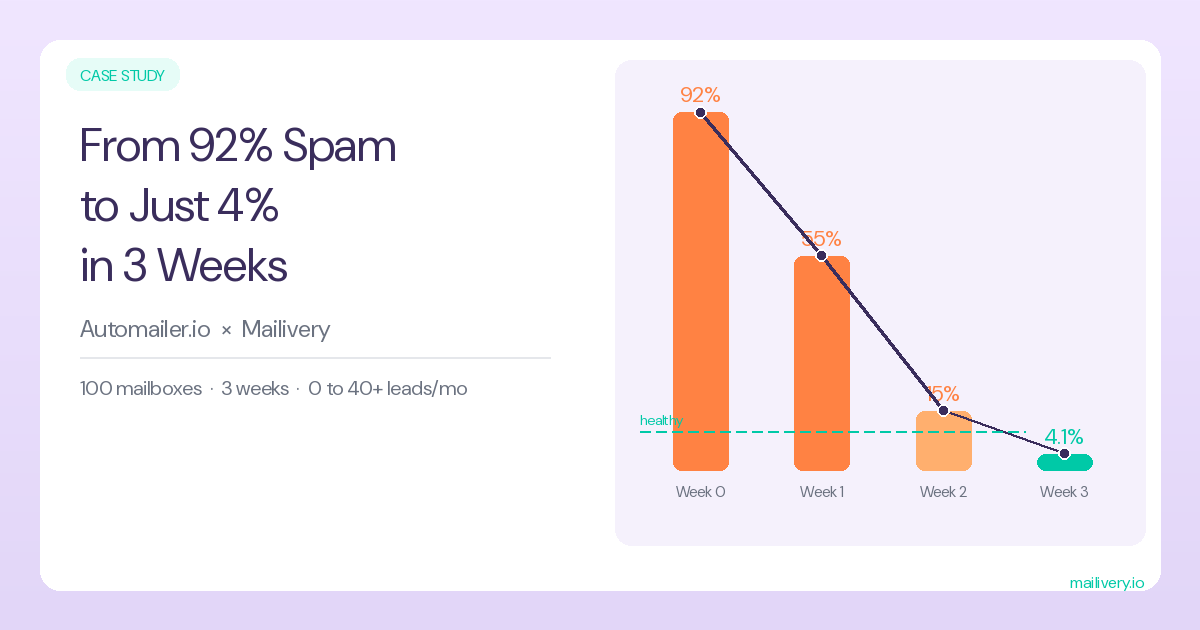
We measured spam rates weekly by tracking how Google Workspace classified incoming messages from the warmed-up mailboxes. This gave us a consistent benchmark across all 100 accounts. Here's what happened:
The spam rate dropped by 96% in 21 days.
The email warmup results tell an interesting story when you look at them week by week.
Unlike typical warmup scenarios where week one is slow, this test saw the spam rate go from 91.7% to 54.9% in the first seven days.
Why the aggressive start? Two reasons. The 45% reply rate generated a high volume of positive engagement signals from day one. And Mailivery's warmup network includes over 100,000 active mailboxes across Google Workspace, Gmail, Outlook, Yahoo, and other providers, which means Google was seeing positive signals from a wide variety of sources, not just one provider type.
54.9% spam is still terrible, but going from 9-out-of-10 emails in spam to roughly 5-out-of-10 in a single week showed the trajectory was heading the right direction fast.
Week two is where the recovery really landed. The spam rate dropped from 54.9% to 15.2%.
This is the compounding phase. The positive engagement from week one gave Google enough data to start reconsidering its classification of these senders. Once that shift begins, it accelerates. Each day of continued warmup reinforces the new pattern, and Google responds by routing more messages to the inbox instead of spam.
By the end of week two, these mailboxes were already in what most deliverability experts would call "workable" territory. Not perfect, but good enough to start seeing real results from outreach.
By week three, the average spam rate hit 4.1%. That's not just healthy. That's excellent. Most senders with established, well-maintained reputations operate somewhere in the 2-8% spam range.
These mailboxes went from completely dead to performing at the level of well-maintained domains in 21 days.
Numbers on a spam rate chart are one thing. Business results are another.
Before warmup, those 100 mailboxes were generating zero leads. Emails were being sent, but they were landing in spam, so prospects never saw them.
After warmup brought the spam rate down to 4.1%, those same mailboxes started reaching real inboxes. Automailer.io's clients resumed their outreach campaigns, and the results followed: over 40 leads per month from mailboxes that were producing nothing just weeks earlier.
That's the part of email warmup that often gets overlooked. Fixing your spam rate isn't just a technical metric to feel good about. It directly translates to pipeline, conversations, and revenue. When you improve email deliverability, the downstream business impact is immediate.
A few things made this recovery possible.
Not all warmup configurations are equal. For severely burned mailboxes, running standard warmup with a low reply rate would have produced slower results. The 45% reply rate was key. It told inbox providers, from day one, that these senders were generating real conversations, not just sending into the void.
Mailivery lets you customize reply rate targets, warmup volume, and timing controls on every plan. That flexibility matters when you're dealing with recovery scenarios that need an aggressive approach.
When Google evaluates your sender reputation, it doesn't just look at engagement with Google users. Signals from Outlook, Yahoo, and other providers factor in too. Mailivery's peer-to-peer warmup network spans all major email providers, so the positive engagement signals hit Google from multiple directions.
A warmup tool that only generates engagement within one provider ecosystem won't rebuild cross-provider reputation as effectively. If you're comparing options, our guide to the best email warmup tools breaks down how different tools handle this.
Running 100 mailboxes on most warmup tools would be expensive. At $15-20 per inbox per month (a common competitor price point), that's $1,500-2,000/month just for warmup. Mailivery charges a flat rate with unlimited mailboxes. The Professional plan at $79/month covered all 100 without any per-inbox fees.
For Automailer.io, that pricing difference meant recovery was economically viable. When the alternative is buying 50 new domains and warming them from scratch, spending $79/month to save existing ones is an easy call.
If you're dealing with burned mailboxes or high spam rates, here are the practical takeaways from this test.
Don't give up on burned domains too quickly. Even at 92% spam, these mailboxes made a full recovery in three weeks. The "buy new domains" reflex costs more money and more time than running warmup on your existing ones.
Increase your reply rate setting when recovering damaged reputation. Standard warmup settings work for maintenance and new domain warmup. For recovery, push the reply rate higher (we used 45%) to generate stronger positive signals faster.
Give it at least two to three weeks. Even with aggressive settings, reputation recovery isn't overnight. Week one shows progress. Week two is typically where the big breakthrough happens. Week three gets you to healthy territory.
Warmup alone isn't enough if you keep doing what burned the domain. Once reputation is recovered, maintain good sending practices: proper list hygiene, gradual volume increases, continued warmup alongside live campaigns. Otherwise you'll end up back where you started.
Yes. In this case study, Mailivery recovered 100 mailboxes that averaged a 91.7% spam rate. After three weeks of warmup at 30 emails per day with a 45% reply rate, the average spam rate dropped to 4.1%. That's a full recovery to healthy levels.
For severely burned domains, this test showed full recovery in three weeks. The biggest improvement came in weeks one and two, with the spam rate dropping from 91.7% to 15.2% in just 14 days. Milder reputation issues can recover faster, and new domains with neutral reputation typically take about two weeks to warm up.
Based on this case study, we recommend 30 emails per day with a 45% reply rate for recovery scenarios. The higher reply rate generates more positive engagement signals, which helps overcome negative reputation faster. For normal maintenance warmup on healthy domains, standard reply rates (20-30%) work fine.
Yes. This test showed clear, measurable improvement every single week. The 100 mailboxes went from 91.7% spam to 4.1% spam in three weeks, and those mailboxes are now generating over 40 leads per month after producing zero before warmup.
Recovery is almost always cheaper. Buying 50 new domains, setting up DNS records, and warming them from scratch costs significantly more than running warmup on existing domains. Mailivery's Professional plan at $79/month covered all 100 mailboxes with unlimited inbox support, compared to $1,500-2,000/month on tools that charge per inbox.
Sending high volumes of cold outreach to unengaged or low-quality lists without proper warmup is the most common cause. When recipients don't open, don't reply, and mark messages as spam, inbox providers like Google reclassify the sender as spam. This compounds over time until nearly everything goes to junk.
Yes. If your emails are landing in spam, warmup generates positive engagement signals (opens, replies, inbox moves) that tell providers your messages are wanted. Based on this case study, you should see significant improvement within the first week, with most of the recovery happening by week two.
Ready to fix your sender reputation? Start your warmup with Mailivery. All plans include unlimited mailboxes, and the Starters plan comes with a 7-day free trial.

The easiest way to get responses to your cold emails.
