

If you've spent any time researching cold email, you've probably seen conflicting advice about warmup. Some people swear by it. Others say it's a waste of money, or that providers have gotten too smart for it to work. A few point to Google cracking down on warmup tools as proof the whole concept is dead.
Email warmup does work in 2026, but with an important caveat: the quality of the warmup tool matters more than it used to. Cheap tools with small, recycled inbox networks produce engagement that Gmail and Outlook increasingly detect and discount. Quality warmup tools with diverse, real inbox networks and varied, AI-generated content still produce measurable improvements in sender reputation and inbox placement.
The concept is sound. The execution is where most people run into trouble.
This post breaks down the evidence on both sides, explains why some warmup tools fail while others work, and helps you figure out whether warmup makes sense for your situation. For the complete how-to, see our definitive email warmup guide.
The logic behind warmup is straightforward. When you create a new email account or domain, inbox providers like Gmail, Outlook, and Yahoo have no data on you. You're an unknown sender. Providers have to decide whether your emails belong in the inbox or the spam folder, and with no history to go on, they default to caution.
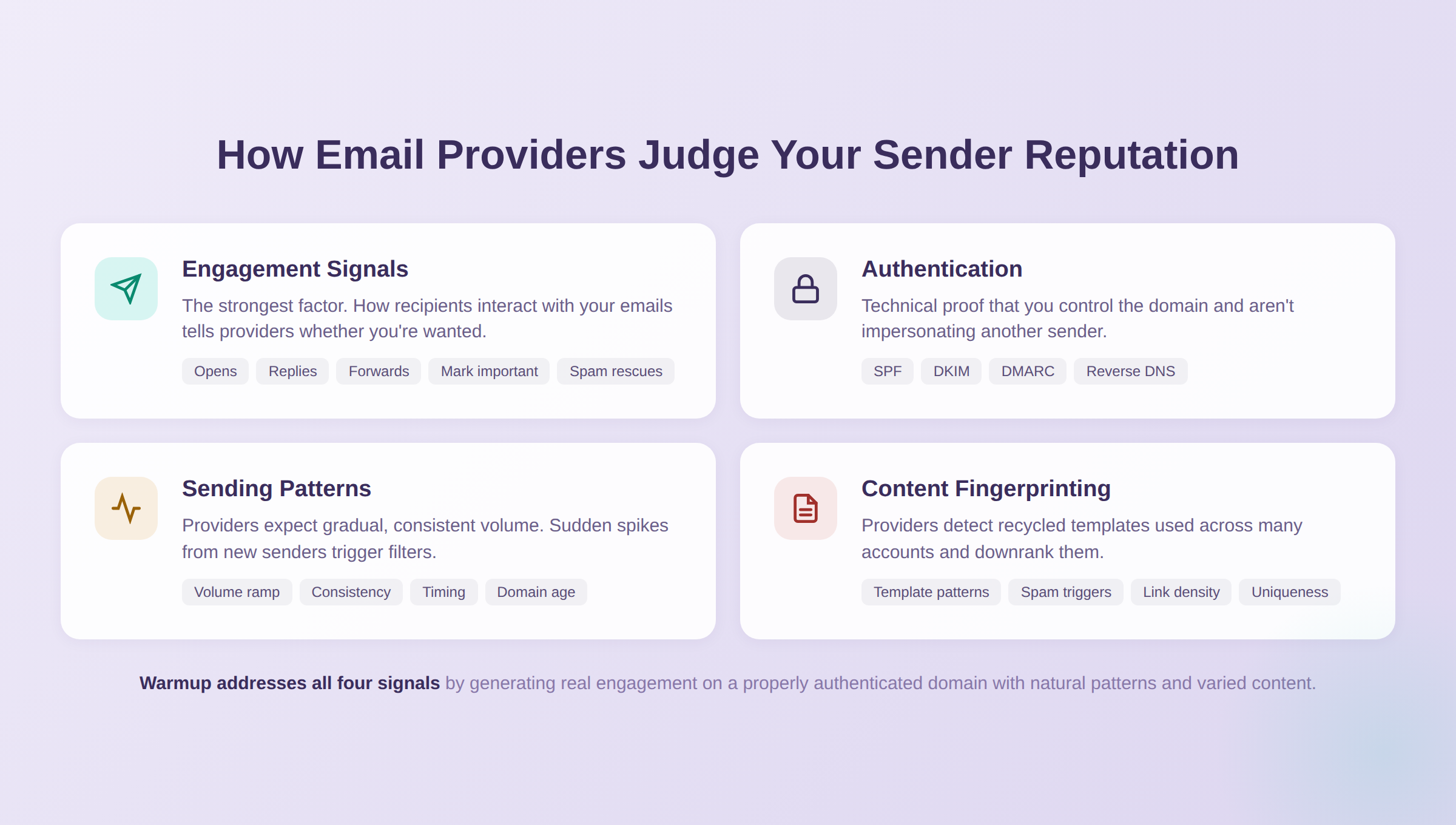
Warmup solves this by generating a track record before you start real outreach. You send a gradually increasing number of emails to real inboxes, and those inboxes open your messages, reply, mark them as important, and pull them out of spam if they land there. Over 2 to 4 weeks, you build a pattern that tells providers: this domain sends emails people want to receive.
That's the theory. And the theory is correct. Providers absolutely use engagement history and sending patterns to make filtering decisions. That part isn't controversial. The debate is about whether warmup tools actually produce the kind of engagement that providers count.
The skeptics have some valid points. Here's what they're reacting to.
In late 2022 and early 2023, Google went after several warmup tools that connected through Gmail APIs. GMass, one of the biggest, shut down its warmup service entirely after Google told them to stop. The founder publicly documented the shutdown, including Google's requirement that he not even mention warmup of Google accounts on his site.
This was real, and it scared a lot of people. But the context matters. Google's issue was with tools that used unauthorized API access to manipulate Gmail accounts. Tools that connect through standard SMTP and IMAP protocols (the same way any email client connects) have continued operating without issue since the crackdowns. Google hasn't targeted SMTP/IMAP-based warmup tools so far, though there's no guarantee they won't in the future. The crackdown targeted the method of access, not the concept of building sender reputation.
This is the most valid criticism. The warmup tool market exploded over the past few years, and many cheap tools cut corners. They use small networks of the same inboxes, recycle identical content across users, and send from low-reputation or disposable accounts.
Gmail and Outlook are run by some of the smartest engineering teams in the world. They can detect when thousands of accounts all interact with the same small pool of inboxes using similar patterns. When they detect this, they discount or ignore the engagement signals entirely. Your warmup dashboard might show great numbers, but your actual sender reputation doesn't improve.
This is a real problem, and it's the main reason some people conclude that warmup doesn't work. Their tool failed. The concept didn't.
You'll find people who say they started cold emailing from a new domain without warmup and got good results. This does happen, especially when the sender has a clean domain, excellent content, a highly targeted list, and low volume. At small scale with good fundamentals, you can sometimes get away with skipping warmup.
But "sometimes works without it" is different from "it doesn't help." Most senders who skip warmup at any real volume end up in spam within the first week. The ones who succeed without it tend to be the exception, not the rule.
Despite the valid criticisms, the fundamentals haven't changed.
Gmail, Outlook, and Yahoo evaluate senders based on engagement signals: opens, replies, forwards, marks as important, spam complaints, and deletions without opening. This is well documented and hasn't changed. If anything, engagement signals have become more important as providers move toward behavioral filtering over simple content-based filtering.
Warmup generates these engagement signals at the exact time when your domain needs them most: the first few weeks of its life when providers have no other data to work with.
When people report that warmup didn't help them, the follow-up question is always: what tool did you use? In nearly every case, it was a cheap service with a small network, recycled content, and no real diversity in the engagement it produced.
Quality warmup tools produce engagement that looks indistinguishable from real email activity because, in many ways, it is real email activity. Real inboxes, varied content, randomized timing, multi-message conversations, and diverse provider coverage. Providers don't discount this engagement because there's nothing artificial to detect.
If you don't warm up, your options are: send cold email and hope for the best (risky), or manually build reputation by emailing friends and colleagues for weeks (tedious and inconsistent). For most teams sending cold email at any meaningful volume, automated warmup is the most reliable path to inbox placement.
Warmup isn't a magic fix for everything. It works best in these scenarios:
For more detail on timing: our day-by-day warmup schedule.
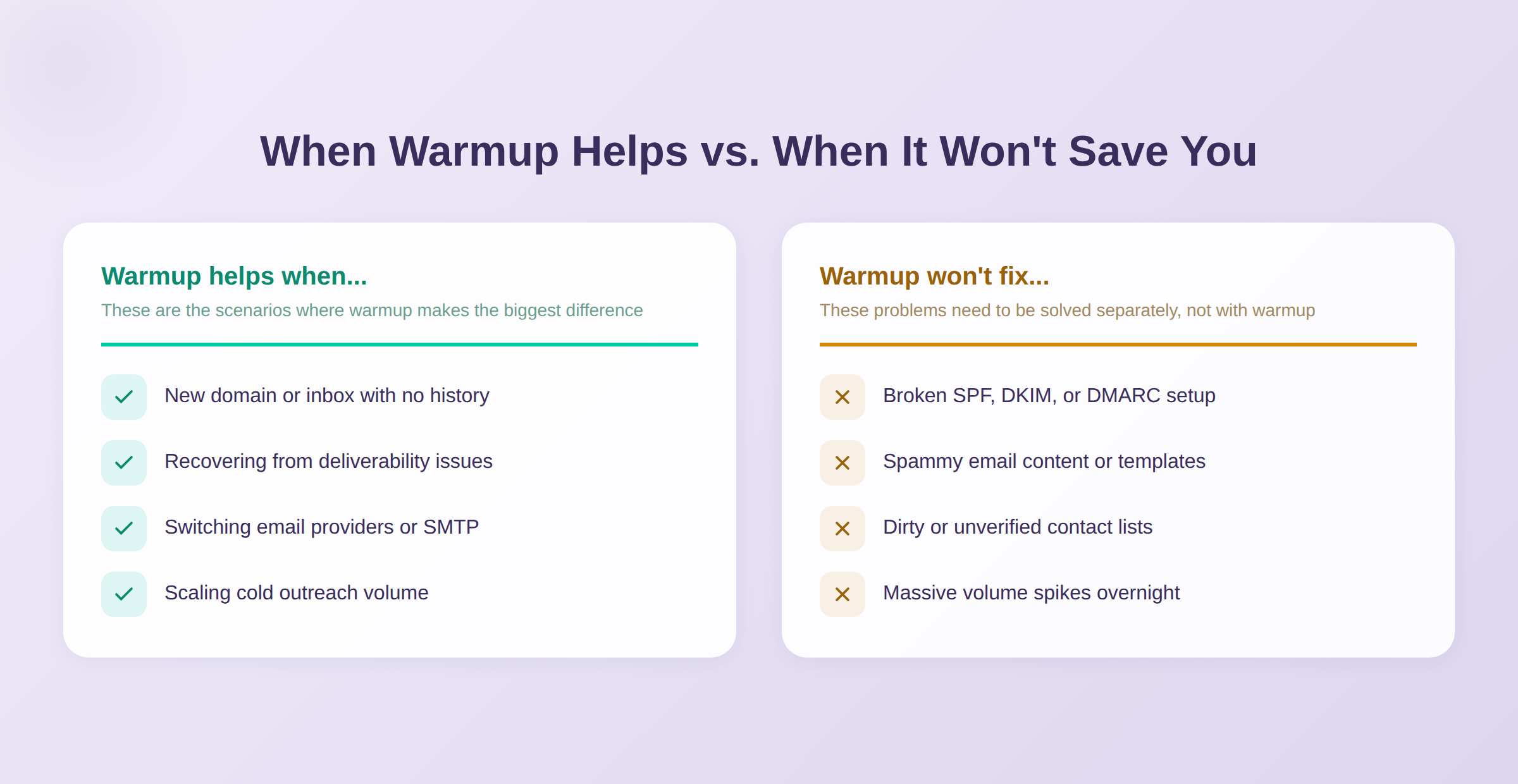
Warmup is not a substitute for good fundamentals. It won't fix these problems:
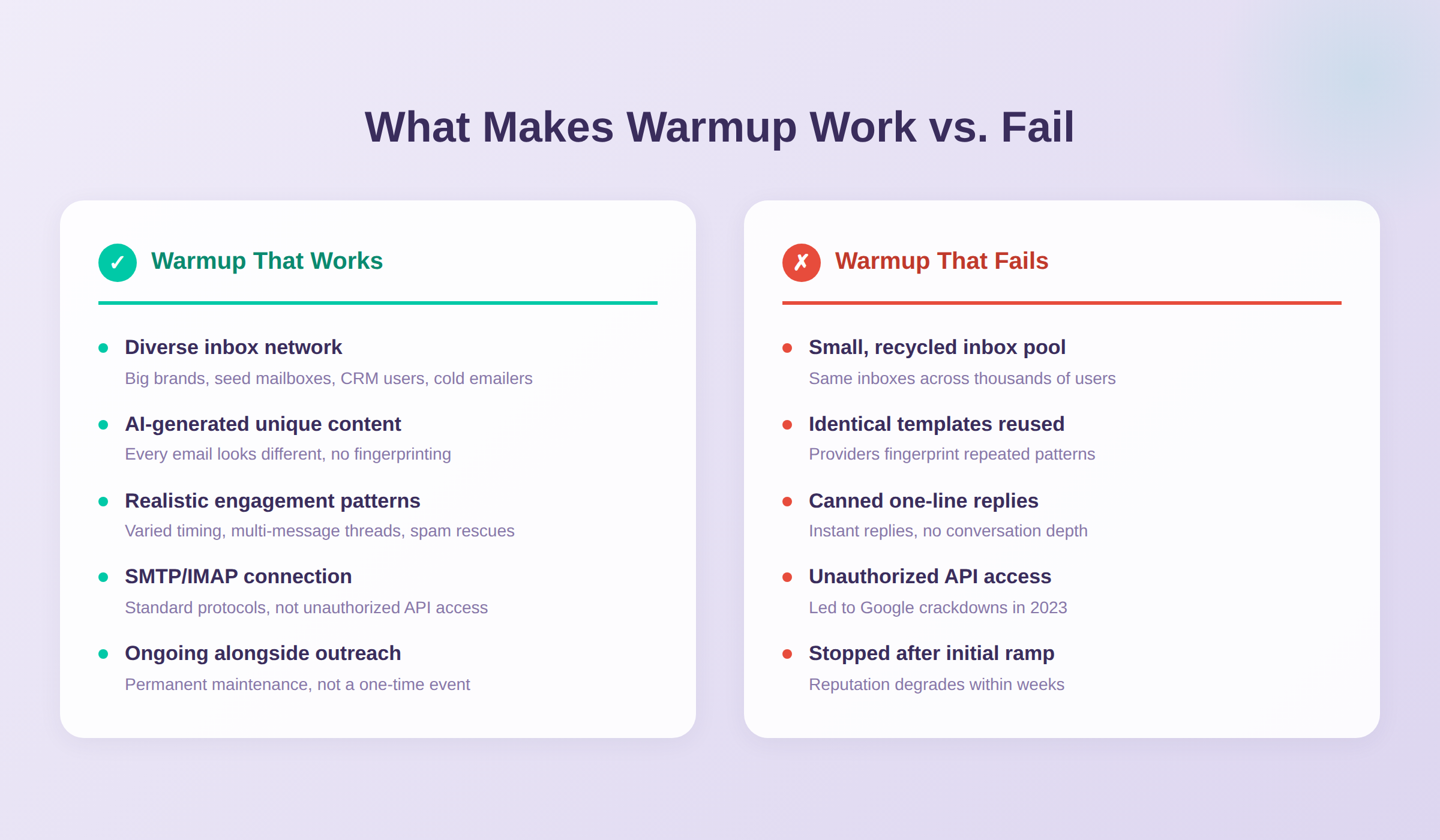
The difference comes down to a few specific factors:
Network diversity. The inboxes in the warmup network need to be real and diverse: big brands, seed mailboxes, CRM users, cold emailers, and more, spread across Gmail, Outlook, Yahoo, and other providers. A network of only disposable accounts created in bulk last month won't cut it.
Content variation. Every warmup email should look different. If the tool sends the same templates (or slight variations of the same templates) across all users, providers will eventually recognize the pattern. AI-generated unique content solves this.
Engagement realism. Opens and replies should happen at varied times with realistic delays. Conversations should include multiple messages. Actions should include marking as important, archiving, and rescuing from spam. A one-line canned reply 30 seconds after delivery doesn't look like real engagement.
Network composition matters. Some warmup tools (especially those bundled with cold email platforms) warm you up inside a pool of other cold senders. A stronger approach uses a diverse peer-to-peer network that includes different types of mailboxes, not just other outbound senders. The more your warmup network resembles normal email traffic, the more natural the engagement signals look to providers. See our breakdown of free vs paid warmup tools for more on this distinction.
Connection method. Tools should connect through standard SMTP/IMAP, not unauthorized API access. This is the lesson from the Google crackdowns. SMTP/IMAP-based tools have continued operating without issue, though the landscape could always shift. No AI agent email warmup that bypasses standard infrastructure.
At Mailivery, we built the warmup specifically to address the problems that make cheap tools fail.
The network is peer-to-peer and diverse: it includes real inboxes from big brands, seed mailboxes, CRM users, cold emailers, and more across major providers. This mix means your warmup interactions look like natural email traffic, not a closed loop of cold senders exchanging messages with each other. Conversations are AI-powered and unique to each user, so there's no pattern for providers to fingerprint. Timing is randomized, engagement is varied (opens, replies, marks as important, spam rescues), and each interaction looks like natural email behavior.
Every plan includes unlimited mailboxes, 70+ blacklist monitoring, email verification, custom warmup templates, API access, and team management. No feature gating. The only difference between plans is daily warmup volume. Plans start at $29/month with a 7-day free trial.
See how the warmup engine works, or compare us against alternatives in our best warmup tools breakdown.
Email warmup works in 2026. The skepticism around it is mostly a reaction to bad tools producing fake engagement that providers have learned to ignore. That's a tool quality problem, not a warmup concept problem.
If you're starting with a new domain, recovering from deliverability issues, or scaling cold outreach, warmup remains one of the most reliable ways to build the sender reputation that gets your emails into the primary inbox. The key is using a tool with a diverse, quality network, varied content, and realistic engagement patterns.
Skip warmup, and you're gambling that providers will trust you without any evidence. For most senders, that's a bet you'll lose.
Start your 7-day free trial with Mailivery
Yes, but only when done correctly with a quality tool. Email warmup builds sender reputation through positive engagement signals that Gmail, Outlook, and Yahoo use to decide inbox vs spam placement. Cheap tools with small, recycled networks produce diminishing results as providers learn to detect them. Tools with diverse, real inbox networks and varied content still produce measurable improvements.
Google cracked down on warmup tools that connected directly through Gmail APIs in 2022-2023. Tools that use standard SMTP/IMAP protocols have continued operating without issue since then. The distinction is important: Google targeted unauthorized API access methods, not the concept of gradually building sending reputation. That said, the landscape could always shift.
You can, but you'll likely land in spam. New or inactive domains have no sender reputation. Providers treat unknown senders as risky by default. Starting cold outreach without establishing positive engagement history first is one of the most common reasons cold email campaigns fail from the start.
Usually because they used a low-quality tool. Cheap warmup services with small networks, recycled content, and disposable inboxes produce engagement that providers increasingly detect and ignore. The tool failed them, not the concept. Quality warmup with diverse real inboxes and varied content still works.
Most senders see initial improvements within the first 1 to 2 weeks, with meaningful reputation building by day 14. Full warmup typically takes 2 to 4 weeks before starting cold outreach. Results depend on domain age, sending history, and warmup tool quality. See our warmup schedule for a detailed timeline.
No. Warmup is one piece of the deliverability puzzle. You also need proper DNS authentication (SPF, DKIM, DMARC), clean contact lists, good email content, reasonable sending volume, and ongoing monitoring. Warmup builds reputation, but bad practices in other areas can cancel it out. See our email deliverability guide for the full picture.

The easiest way to get responses to your cold emails.
