
.png)

Last updated: July 2026.
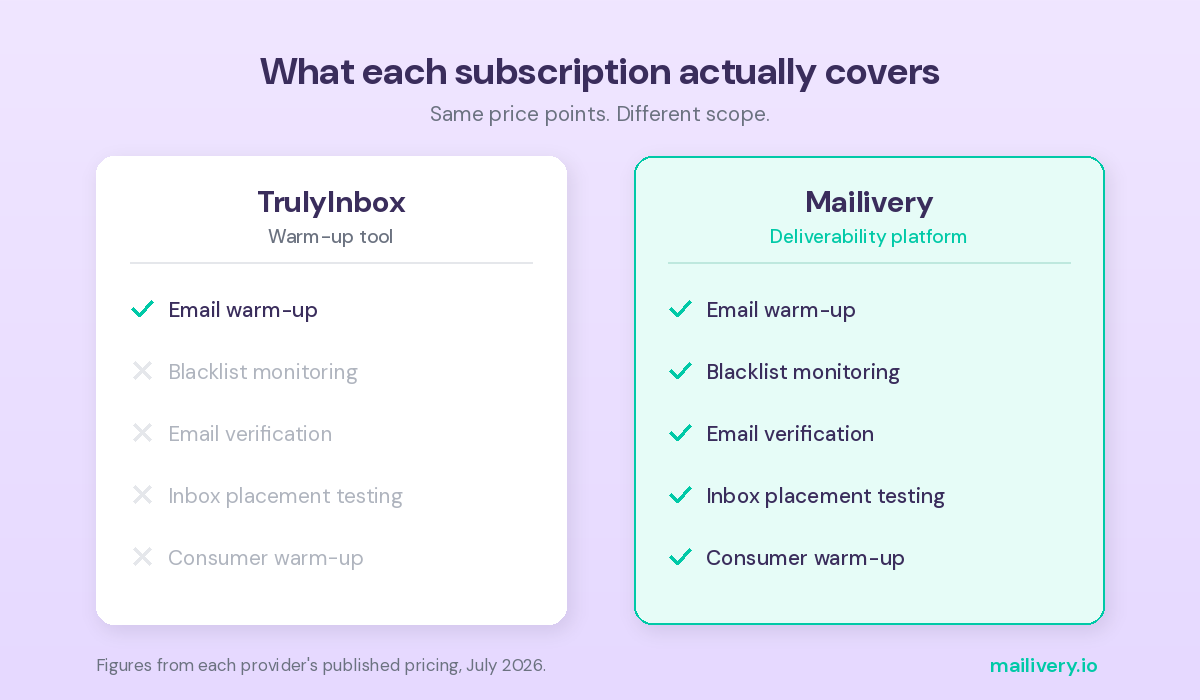
Quick answer: TrulyInbox is a warm-up tool. Mailivery is a deliverability platform that includes warm-up, blacklist monitoring, email verification, and inbox placement testing on every plan from $29. Both connect unlimited mailboxes and price by daily volume, but only Mailivery covers B2B and consumer sending.
TrulyInbox is one of the few warm-up tools that does not charge per inbox, and that is the right pricing model. We know, because we moved to it first and TrulyInbox followed. Today both products charge for the warm-up emails you send rather than the mailboxes you connect.
Which makes the usual comparison useless. The line that flat pricing beats per-inbox pricing does the work against MailReach or Warmup Inbox. It does nothing here. Both tools connect unlimited mailboxes and cap you on daily volume instead.
The real difference is category. TrulyInbox sells warm-up. Mailivery sells deliverability, and warm-up is one component of it. If you are new to how any of this works, our email warm-up guide covers the mechanics before you compare products.
Here is what that category difference costs and what it gets you.
Warm-up alone does not tell you whether your emails reach the inbox. It builds sender reputation, then leaves you to find out the hard way whether it worked.
Three things close that loop. Blacklist monitoring tells you if your domain or IP got flagged. Email verification stops you sending to addresses that bounce and damage reputation faster than warm-up repairs it. Inbox placement testing shows where your mail actually lands across Gmail, Microsoft, and Yahoo.
Mailivery includes all three on every plan, starting at the $29 tier. TrulyInbox includes none of them, because it is a warm-up product.
Bought separately, placement testing alone runs $40 to $100 a month from GlockApps or InboxAlly, before you add a verification tool and a monitoring service.
Warm-up quality comes down to who is on the other end of the conversation.
Mailivery runs a peer-to-peer network of 100,000+ active mailboxes, with 2,000+ companies warming across it. That mix matters more than the raw number. Real business mailboxes, seed accounts, CRM users, and dedicated warm-up inboxes produce engagement patterns that look like actual correspondence, because much of it is.
The consumer side is the part most warm-up tools cannot offer. If you send newsletters, transactional mail, or promotional campaigns to consumer inboxes, a B2B-only network teaches inbox providers the wrong thing about your sending. Mailivery warms against both. TrulyInbox is built around cold outreach and B2B sending.
TrulyInbox does not publish a network size, so we cannot compare that figure directly and are not going to guess at one.
Mailivery has been running warm-up since well before the current wave of tools, and platforms build on top of it rather than just subscribing to it.
Woodpecker and Skylead embed Mailivery warm-up inside their own products through our REST API. Automailer, MailClickConvert, List Match, and Cold Email Hustle run on it. That is a different kind of validation than a review count. Platforms integrating warm-up into their product put their own deliverability reputation on the line, and they audit accordingly before committing.
TrulyInbox is built by Saleshandy and ships included with the Saleshandy paid plans. If you already run Saleshandy for outreach, you may effectively have TrulyInbox already, which is a genuine advantage worth weighing.
Both products cap total daily warm-up sending across all connected mailboxes, with a per-mailbox limit underneath.
Mailivery runs 200 warm-up emails per day at $29, 800 at $79, and 2,500 at $199. TrulyInbox runs 100 per day at $29, 1,000 at $79, and 3,000 at $189. Annual billing takes 25% off on both sides, which is where most third-party comparisons go wrong by mixing the TrulyInbox annual rates ($22 and $59) against monthly rates from other tools.
So Mailivery gives twice the volume at the entry tier, and TrulyInbox gives more at $79 and above.
If warm-up emails per dollar is your only measure, the upper TrulyInbox tiers win that specific comparison. We would rather say so plainly. But that comparison prices a warm-up tool against a deliverability platform. At $79 the actual trade is 800 warm-up emails plus 10 blacklist monitors, 500 verification credits, and 30 placement tests, against 1,000 warm-up emails and nothing else.
There is also a limit worth knowing before you scale. The TrulyInbox help documentation states that when you hit the total daily limit on your plan, the first email account you connected stops sending. Not a proportional reduction across the fleet. The mailbox you have been warming longest goes quiet, and nothing announces it.
TrulyInbox is the better pick in four cases. You want maximum warm-up volume for the lowest cost above $79. You already own separate placement testing and verification tools. You are already paying for Saleshandy. Or you want a free plan to test the concept before spending anything.
Mailivery is the better pick if you want your full deliverability stack in one subscription rather than three. It also fits if you send to consumers as well as businesses, need full warm-up control without paying $189 for it, or run a platform embedding warm-up through an API. Our email warm-up tool page covers how that works in practice.
Every figure here came from the pricing page and documentation published by each product in July 2026, not from third-party review sites, which routinely confuse annual and monthly rates.
We compared at matched monthly price points rather than matched feature names, since both products define plans by volume rather than seats. Where a claim comes from a vendor rather than our own measurement, we have said so. Placement rate claims from any warm-up vendor, ours included, are not independently audited, so treat them as directional and run your own placement tests.
For the wider field, see our best email warm-up tools comparison.
At $29 a month Mailivery includes 200 daily warm-up emails against 100 on TrulyInbox, plus blacklist monitoring, verification, and placement testing that TrulyInbox does not offer. At $79 TrulyInbox includes more raw warm-up volume. Which is cheaper depends on whether you need the rest of the deliverability stack.
Blacklist monitoring across 70+ lists, email verification credits, and inbox placement testing across Gmail, Microsoft and Yahoo. You also get consumer as well as B2B warm-up, a full REST API, and automatic filing of warm-up mail so it never clutters your real inbox. All on every plan including the $29 tier.
Yes. Neither charges per inbox. Both cap total warm-up emails sent per day across all connected mailboxes, so volume is the practical limit rather than mailbox count.
Mailivery warms against both business and consumer mailboxes, which matters for newsletters, transactional, and promotional sending. TrulyInbox is built around B2B cold outreach, so consumer senders are training reputation against the wrong signal mix.
The TrulyInbox documentation states the first email account you connected stops sending once the total daily limit on your plan is reached. Mailivery balances sending across your connected mailboxes within the shared daily pool on your plan.
Yes, a full REST API on every plan. Platforms including Woodpecker and Skylead use it to build warm-up directly into their own products. TrulyInbox has listed API access as planned rather than shipped.
Both are comparable. New mailboxes generally need three to four weeks before deliverability stabilizes, and previously damaged accounts two to three weeks depending on severity. Neither tool recovers a blacklisted or suspended account.
TrulyInbox scales from 25% up to 65% across its tiers. Mailivery caps at 30% on Starter and 55% above that. Higher is not automatically better, since unusually high reply rates can read as unnatural to filters.
Warm-up on its own leaves you guessing. Start a 7-day Mailivery trial, run an inbox placement test against your current setup, and see where your mail is actually landing before you decide.

The easiest way to get responses to your cold emails.
